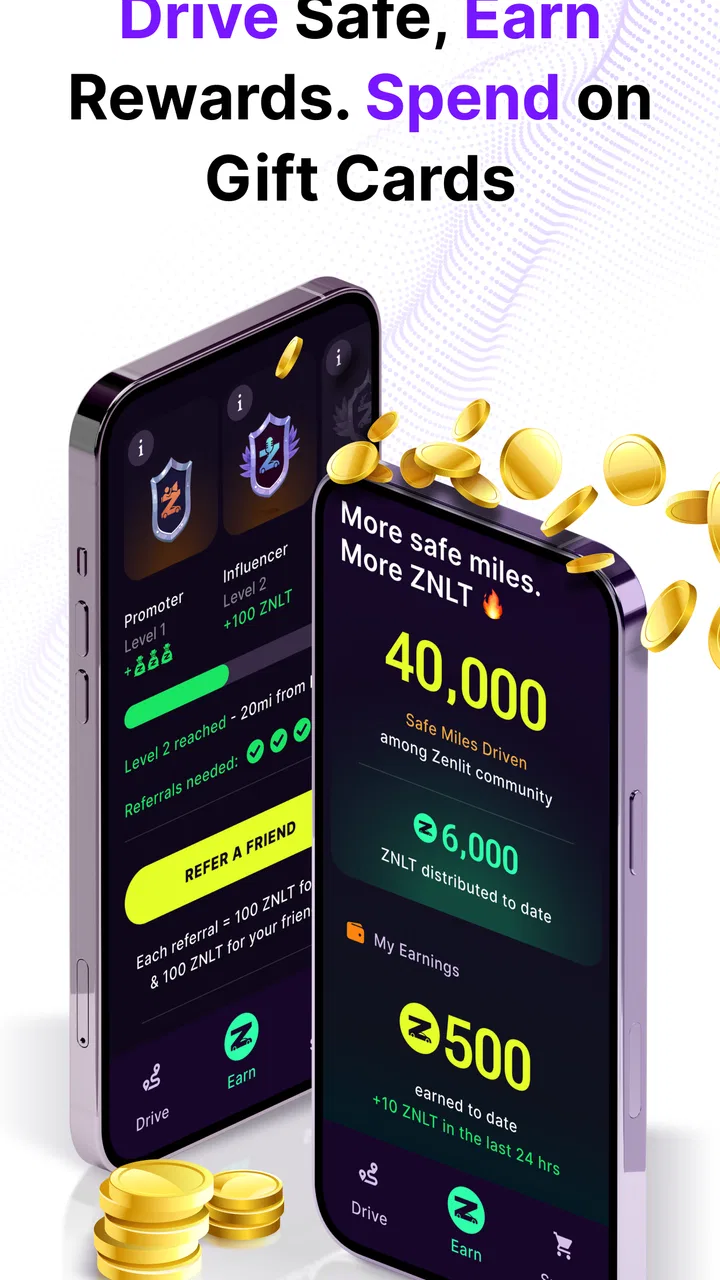
Zenlit: Drive, Earn and Save
- 4.3
- Rating
- 100.00K
- Installs
- Free
- Price

 Analysis by App-foxy
I tried Zenlit as a driving-focused travel and local app, and my first impression was that it is built around a simple idea: ordinary trips should feel a little more rewarding when they are recorded as safe driving. That makes it different from a standard navigation tool. It is not primarily about finding a restaurant, comparing hotels, or replacing a dedicated map app. Its appeal is the possibility of turning routine time behind the wheel into something with an extra benefit attached.
The app is developed by Telenav, Inc., is free to use, and carries an Everyone age rating. It reached the store on July 14, 2025, and the current release is version 2.4.19 for devices running Android or iOS 10 and later. Those details make it accessible to many households, especially people using an older phone that still handles their everyday travel needs. The bigger question is not whether it is easy to download, but whether its reward-oriented approach fits the way you and the people around you actually drive.
How Zenlit fits into a shared household
The most natural household scenario is a family with more than one regular driver. Imagine a parent commuting during the week, a partner making school or shopping trips, and a young adult using the same car on weekends. Instead of treating every journey as an isolated drive, the household can consider Zenlit as one more tool for encouraging calmer, safer habits. That sounds modest, but it can change the tone of routine driving when the reward element gives people a reason to pay attention to how they travel.
You May Also Like

 Blood Strike: 2.5 Anniversary
Blood Strike’s Loadouts Turn Every Drop Into a Tactical Gamble
A close look at Blood Strike’s custom loadouts: how fast access to signature weapons reshapes its battle royale rhythm, rewards preparation, and narrows the gap between fights.

 Pandora - Music & Podcasts
Pandora’s Music Is Easy to Start, but Harder to Recover
Pandora’s strength is its low-effort path from a seed to a station. Its weak spot is how much confidence it asks you to place in connection, setup, and quiet recovery.

 8 Ball Pool
 Is Built on Rivalries, Rematches, and Routine
A close look at the rivalries, rematches, shared routines, and unanswered safety questions that turn a quick pool match into a persistent mobile community.

 Samsung Music
’s Quiet Strength Is Playing What You Already Own
Its reach comes less from spectacle than from dependable access to a personal library. That simplicity is both the app’s strongest retention engine and its ceiling.

 AccuWeather: Weather Radar
AccuWeather Review: A Quick, Clear Forecast for Everyday Decisions
For everyday plans, the best forecast is the one you can understand quickly. AccuWeather makes rain timing, radar, and local conditions easy to act on, with a few trade-offs.

 Hill Climb Racing
Why Hill Climb Racing Still Turns Crashes Into One More Run
A tiny car, a bumpy hill and one more upgrade: Hill Climb Racing keeps resurfacing because its simple chaos makes every near-miss feel personal.
More From Our News Desk



I would not treat it as a shared dashboard by default. A family should decide who is using which account and which phone before anyone starts driving. If several people simply pass one device around, the resulting activity may be difficult to interpret. The app is most useful when the person holding the phone is also the person whose driving behavior the account is meant to represent. That boundary is easy to overlook in a household where vehicles and phones are shared.
For a practical test, I would begin with one regular driver and one device rather than installing it everywhere at once. That gives the household a cleaner sense of how the app fits into a real routine. Use it for commuting, errands, or repeated local routes, then decide whether the reward concept actually encourages better attention. A short trial like this is more informative than asking every family member to change their habits immediately.
The app’s store summary focuses on real-world perks for better driving and rewards for safe trips. In my view, that positioning is strongest when it remains a gentle prompt rather than becoming a competition. Safe driving should not turn into a race to collect more activity. If someone starts taking unnecessary trips or driving while distracted because they are focused on the app, the entire purpose is defeated.
Setting boundaries before the first trip
Setup deserves more thought than the download itself. Before using Zenlit in a shared car, I would agree on who is responsible for opening the app, checking its status, and handling the phone. The driver should not be expected to interact with a screen while moving. A passenger can manage the device before departure, but the safest routine is to prepare everything while parked and leave the phone alone once the vehicle is in motion.
This is also where account boundaries matter. A shared household can have several drivers, but that does not automatically mean one account is suitable for everyone. Keep each person’s use consistent enough that the record reflects the right driver. If a parent and teenager alternate on the same phone, decide in advance whether they will use separate accounts or whether the household will keep the app limited to one person. The important point is to avoid confusing one driver’s trips with another’s.
I would also be cautious about treating the app as proof of driving quality. A reward record can encourage good habits, but it should not become the sole basis for judging a family member. Driving conditions vary. A short urban trip with frequent stops is not comparable to a quiet highway journey, and a person may need to respond differently to traffic, weather, or road design. The app can support a conversation about safe driving; it should not replace common sense or direct supervision.
Another useful boundary is deciding when the app is not worth using. If a driver is already overwhelmed by navigation, calls, passengers, or unfamiliar roads, adding another app to the routine may create friction. On those trips, I would prioritize attention and use the phone only for the essential travel task. Zenlit makes more sense on familiar routes where the driver can prepare before leaving and then ignore the screen.
Coordinating trips without turning rewards into pressure
For households, coordination is less about managing a fleet and more about agreeing on a repeatable routine. One person can remind everyone to prepare the app before departure, while each driver remains responsible for their own phone and account. That division prevents a common problem with shared technology: everyone assumes someone else has handled the setup.
A useful routine is to check the app only when parked. Before a commute, the driver can confirm that the correct account is active and that the phone is positioned safely. After arriving, they can review the result if they want to. This creates a clean separation between driving and checking progress. It also keeps the reward element from becoming an excuse to touch the phone in traffic.
In a family with several drivers, I would avoid daily comparisons. A better approach is to talk about whether the app changes behavior in a positive way. Does it make someone more patient? Does it encourage smoother, less distracted trips? Does it fit naturally into the commute without adding work? These questions are more useful than asking who earned the most, particularly when people drive different distances and routes.
There is a practical trade-off here. A single household may appreciate having a common theme around safe driving, but the app’s value can become diluted if too many people use it inconsistently. If one person records every trip and another opens it only occasionally, comparisons will not mean much. Keep the arrangement simple: consistent users, clear account ownership, and no expectation that every journey must be tracked.
For someone who drives for work, the decision is even more personal. A delivery worker, rideshare driver, or frequent commuter may spend far more time on the road than other household members. That person may find the reward concept more relevant, but they also face more opportunities for interruptions and fatigue. I would recommend treating Zenlit as a background companion, not as a reason to extend a shift or add unnecessary mileage.
Age, trust, and the meaning of an Everyone rating
The Everyone rating makes the app broadly suitable from an age-classification perspective, but that does not mean every child should be treated as an independent driver. Younger household members may use a phone connected with an adult’s travel routine, yet the responsibility for safe driving remains with the licensed driver. Parents should explain that the app is not a game to operate while the car is moving.
For a newly licensed teenager, Zenlit could be introduced as part of a wider conversation about calm and attentive driving. I would make the boundaries explicit: prepare before leaving, never handle the phone in motion, and do not chase rewards by taking extra trips. The app can be a small motivational aid, but it should not be presented as a substitute for practice, instruction, or parental judgment.
Trust also matters between adults. If one partner installs the app on a shared phone, both people should understand whose activity is being recorded and why. A reward-oriented driving app can feel uncomfortable if one person believes it is being used to monitor another without agreement. Clear consent and straightforward communication are more important than squeezing every possible benefit from the service.
I would be especially careful with household expectations around privacy and personal devices. The fact that an app is free does not make it automatically appropriate for every family arrangement. Before regular use, discuss whether everyone is comfortable with the app being part of their driving routine. If a family member prefers not to use it, that decision should be respected rather than framed as a lack of commitment to safe driving.
This is one reason I see Zenlit as better suited to voluntary participation. Its strongest effect is likely to come from drivers who enjoy the idea of earning something from safer trips. It is less convincing when imposed as a surveillance tool or used to pressure someone into sharing every journey. The household benefit depends on trust, not just installation.
What stands out compared with ordinary travel apps
Most travel and local apps solve an immediate problem: they help me find a route, locate a nearby place, organize a booking, or check information about a destination. Zenlit approaches driving from another direction. Its central appeal is not simply getting somewhere; it is attaching a reward-oriented experience to the way the trip is made. That gives it a different role from maps and navigation services.
I would still keep a conventional navigation app available when I need detailed directions, live route decisions, or broad location search. Zenlit should not be chosen as a replacement just because it is in the travel category. The two types of app can serve different purposes, but the driver should avoid juggling them on the road. Prepare navigation first, then leave the phone alone. If the journey requires frequent route changes, Zenlit may be better left in the background or skipped for that trip.
Compared with a basic driving log, Zenlit has a more motivating angle. A manual log can record mileage or expenses, but it usually depends on the driver remembering to enter information. Zenlit’s attraction is that the trip is connected to safe-driving rewards rather than being merely a recordkeeping chore. The trade-off is that a reward system may feel less useful to someone who wants precise business documentation or detailed vehicle maintenance records.
It also differs from an insurance-focused driving program in how I would approach it. Insurance tools are often judged by their effect on premiums or formal driving assessment, while Zenlit is easier to view as a voluntary everyday incentive. That may make it feel less intimidating, but it also means I would not use it as a definitive measure of risk. Someone looking for official insurance feedback should choose a service designed specifically for that purpose.
Small details that affect everyday usefulness
The first non-obvious lesson is that the phone routine matters more than the reward itself. If starting a trip requires last-minute tapping, the app can become a distraction. The best workflow is prepared and boring: choose the right account, place the phone safely, begin the journey, and do not interact with it until parked. Any app that encourages safer driving must fit into that discipline rather than compete with it.
The second is that shared-device use can blur the meaning of progress. If a household rotates one phone between drivers, a reward record may represent several people. That may be acceptable if the family only wants a shared incentive, but it is unsuitable if each person expects an accurate personal history. Decide whether the goal is individual consistency or a loose household habit before relying on the app’s results.
The third is that repeated routes are the best place to judge whether Zenlit helps. A familiar commute gives me a stable routine in which the app can remain unobtrusive. A one-off trip through an unfamiliar city has different demands and may require navigation decisions, parking searches, and passenger coordination. In that situation, the reward function should be secondary to getting there safely and calmly.
A fourth insight is that rewards work best as reinforcement, not as a target. If a driver begins optimizing for the app, the incentive has become counterproductive. Do not add detours, extend errands, or drive when there is no real need simply to create more activity. The sensible test is whether the app makes necessary trips feel more purposeful, not whether it creates new trips.
Finally, the app’s value may vary sharply inside one household. A regular commuter could appreciate a small motivation during repetitive drives, while a person who rarely drives may see little reason to build another routine. That is not a flaw so much as a reminder that the product is not equally relevant to every member of a family. Voluntary use will produce a better result than forcing universal adoption.
Who should use it, and who should pass?
I can recommend Zenlit to drivers who want a light incentive for safer everyday travel and who are comfortable preparing an app before setting off. It is particularly interesting for households trying to encourage calmer driving without turning the conversation into a lecture. The free price removes an obvious barrier, and the broad age classification makes it easy to consider for a mixed-device home, provided adults set sensible boundaries.
I would be more cautious for people who need a full navigation replacement, formal mileage records, vehicle diagnostics, or detailed driving analytics. Zenlit’s reward-centered approach does not automatically cover those needs. A dedicated navigation service is better for complex directions, a mileage tracker is better for expense documentation, and a vehicle-focused tool is better for maintenance or mechanical information.
I would also skip it on trips where the driver is likely to interact with the phone repeatedly. New drivers, people managing difficult traffic, and anyone already feeling tired should not add another layer of attention. The safest use is passive: prepare while parked and let the drive remain the main task.
The app has a 4.4 average from around 765 ratings, with roughly 228 written reviews, and it has passed 50 thousand installs. Those figures suggest that it has attracted a meaningful early audience, but I would still judge it by personal fit rather than popularity. A reward app can be appealing in principle and still fail to become part of a particular household’s routine.
My household verdict
After looking at Zenlit through the lens of shared cars, shared phones, and different driving ages, I see it as a focused companion rather than an all-purpose travel application. Its strongest idea is making safe driving feel more tangible during ordinary trips. That can be useful when participation is voluntary, accounts are kept clear, and nobody is tempted to touch the phone while moving.
My recommendation is to start small. Choose one regular driver, use one consistent device, prepare the app before departure, and review whether it adds encouragement without adding distraction. If a family later wants to include more drivers, agree on account ownership and avoid treating the resulting activity as a precise ranking. That simple approach preserves the app’s positive side while avoiding the confusion that shared use can create.
Zenlit is worth trying for households that want a gentle safe-driving incentive, not for people searching for a complete navigation or driving-management system. I like its everyday premise, especially for repeat commutes and routine errands, but I would keep expectations realistic. The best result is not a bigger reward record; it is a calmer driving habit that remains sensible even when the phone is put away.
For me, that is the deciding point. If the app stays in the background and gives drivers a small reason to maintain good habits, it earns a place in the household toolkit. If it creates account confusion, comparison, or phone interaction behind the wheel, the better choice is to leave it unused on that trip. Used with those boundaries, this free Travel & Local app from Telenav, Inc. offers a distinctive idea without needing to replace the tools drivers already rely on.
FAQs for Zenlit: Drive, Earn and Save
01What is Zenlit: Earn While You Drive?
Zenlit is an innovative app designed for drivers who want to earn extra income while on the road. By displaying advertisements on your vehicle, you can earn money based on the distance you drive and the locations you cover. It seamlessly integrates with your daily commute, turning your car into a moving billboard.
02How does Zenlit track my driving for earnings?
Zenlit uses GPS technology to track your driving routes and calculate earnings. The app monitors the distance you travel and the areas you cover to determine how much you earn. This data is securely managed, ensuring your privacy while providing accurate compensation for your advertising efforts.
03Is Zenlit available for both Android and iOS devices?
Yes, Zenlit is available for download on both Android and iOS platforms. You can easily find it on the Google Play Store for Android devices and the Apple App Store for iOS devices. The app is user-friendly and optimized for a seamless experience across different smartphones.
04Are there any costs or fees associated with using Zenlit?
There are no upfront costs or subscription fees to use Zenlit. The app is free to download and use. You earn money based on the advertising campaigns you participate in, so there’s no financial outlay required from you to start earning while you drive.
05How can I maximize my earnings with Zenlit?
To maximize your earnings with Zenlit, focus on driving through densely populated areas and during peak hours when traffic is high. The more visibility your vehicle gets, the more you can earn. Regularly check for new advertising campaigns within the app to take advantage of higher-paying opportunities.
Pros
- Earn passive income while driving.
- Simple and user-friendly interface.
- Minimal impact on battery life.
- No intrusive ads or disruptions.
- Supports multiple payment methods.
Cons
- Requires constant GPS access.
- Limited to certain regions.
- May affect phone performance.
- Needs frequent app updates.
- Not compatible with all vehicles.

Zenlit: Drive, Earn and Save
Gallery